“Kumbh ke Mele mein bichde huye bhai” – a Bollywood catchphrase born from the fictional plot where families separated at the Kumbh Mela & then dramatically reunited. But behind these stories was a real-life hero who spent his life reuniting countless families.

For 71 years, Raja Ram Tiwari was on a singular mission: to help people who had become separated from their families in the overwhelming crowds of the Kumbh Mela, one of the largest religious gatherings in the world.
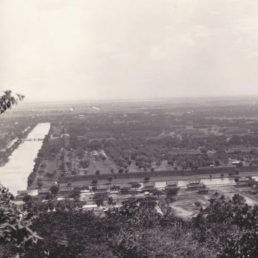
Held on a sprawling site of thousands of acres, the Mela sees millions of pilgrims gather for a sacred dip in the holy rivers. Amid such chaos, families inevitably get separated, and that’s where Tiwari’s “Khoya Paya Shivir” (Lost and Found Camps) came in.
Born in Gaura Nandook Pura village, Pratapgarh, Raja Ram Tiwari was the son of Janki Devi and Pandit Jagan Prasad. He grew up in a modest household, studying at Allahabad University before being drawn into the spiritual heart of India—the Kumbh Mela.
It was in 1946, at the age of 18, Tiwari attended the Kumbh Mela for the first time. During his visit, Tiwari witnessed a heartbreaking scene. An elderly woman was crying uncontrollably in the crowd. She had lost her companion, and there was no one to help her.
Without a second thought, young Tiwari sprang into action. He fashioned a makeshift ‘Bhopu’, a simple loudspeaker out of a tin can, and began calling out for the woman’s companion. His voice rang out through the massive crowd, and miraculously, the two were reunited.
The woman, overwhelmed with gratitude, touched Tiwari’s feet—a gesture normally reserved for elders. That moment stuck with Tiwari. The feeling of reuniting a lost soul with their loved one ignited a lifelong mission.
He knew something needed to be done to help the countless others who became lost in the massive crowds at the Kumbh. He set up the first ‘Khoya Paya Shivir’, a lost-and-found camp, and from there, his life took a new turn.
What started as a small initiative quickly turned into an extraordinary legacy. Tiwari’s Khoya Paya Shivir became a lifeline for the pilgrims who lost their way. Over 70 years, he was able to reunite more than 14 lakh adults and around 21,000 children with their families.
While the Kumbh Mela drew millions of devotees, many would get separated amidst the massive crowds. Some reunions took only a few hours, while others stretched for days. Tiwari recalled cases where it took months. But no matter the difficulty, he never gave up on anyone.
In the early days, Tiwari’s methods were simple: loudspeakers, handwritten signs, and word of mouth. But as technology evolved, so did his efforts. He began recruiting a team of over 150 volunteers, and together they set up an organized system for finding lost pilgrims.
While most separations were brief, there were a few extraordinary cases. One such case involved a deaf and mute woman who had become lost at the Mela. She couldn’t speak or write, and for a while, her family seemed unreachable.
Unable to speak her husband’s name, she pointed towards a green leaf on a nearby tree. After some observation, Tiwari understood: her husband’s name was ‘Hari’.
This simple gesture was all it took for Tiwari’s team to track down her husband. After 10 days of relentless searching, Tiwari’s team finally tracked down her family and reunited them.
But Tiwari’s work wasn’t without heartbreak. In 1999, a two-and-a-half-year-old boy was found, separated from his mother. For a month, Tiwari and his team made countless announcements and distributed pamphlets, but no one came forward to claim him.
In the end, the boy was put up for adoption, and a childless couple welcomed him into their home. Raja Ram Tiwari went above and beyond to ensure the child was cared for, extending his efforts far beyond the usual boundaries to ensure the boy’s well-being.
Tiwari’s story is more than one of service—it is one of compassion. He never charged money. He didn’t just see these people as lost pilgrims; he saw them as family, each person deserving to be found and returned to the arms of their loved ones.
Tiwari breathed his last at the age of 88 in 2016. But the Khoya Paya Shivir continues to run. He restored humanity amidst the chaos of one of the world’s largest gatherings. He was popularly known as ‘Bhule Bhatke Tiwari‘ or ‘Bhule Bhatke Walon ka Baba‘.
Though the media often covers his work, each Kumbh Mela, his name should be amplified more than anyone —because, the life of ‘Bhule Bhatke Walon ka Baba’ is a testament to the highest form of Dharma: upholding humanity above all.
Sources:
Pti. (2019, February 6). “Bhule Bhatke”: Reuniting Kumbh Mela’s lost people since 1946. The Economic Times. economictimes.indiatimes.com/news/politics-
Desk, I. T. W. (2016, August 27). All you need to know about bhule bhatke Baba, man who reunited lost Kumbh Mela pilgrims. India Today. indiatoday.in/fyi/story/bhul
SBS Language. (2019, January 16). Kumbha Mela’s Bhoola-Bhatka camp. sbs.com.au/language/hindi
BBC NEWS | World | South Asia | The man who reunites families. (n.d.). news.bbc.co.uk/1/hi/world/sou
वर्मप. (2016, September 7). ‘भूले-भटके’ तिवारी : जिन्होंने कुंभ में बिछड़े लाखों लोगों को उनके अपनों से मिलवाया. Tehelka Hindi. tehelkahindi.com/obituary-to-so
Times, M. M. L. A. (2019, March 15). Lost — and found — in a sea of tens of millions at India festival – Los Angeles Times. Los Angeles Times. latimes.com/world/la-xpm-2